

Granite tiles – types and applications
-
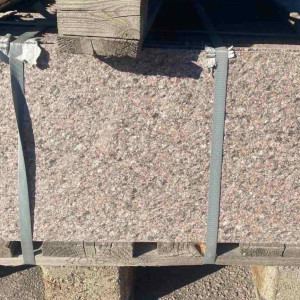 Tile flamed brown granite Carpazi 600x300x30 mm€52.20
 -
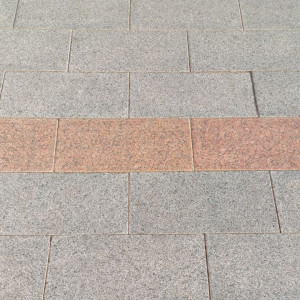 Flamed tile from grey granite 600x300x20 mm€31.50
 -
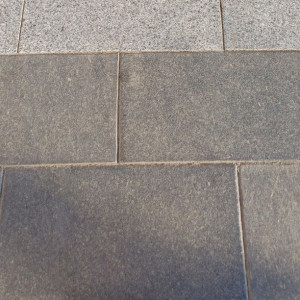 Flamed black stone tiles Gabbro 600x300x20 mm€44.30
 -
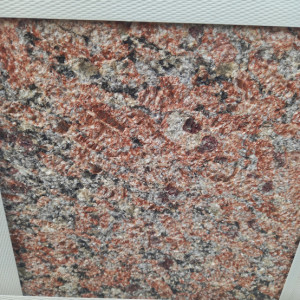 Flamed tile from red granite Rosso Santiago 600x300x30 mm€43.40
 -
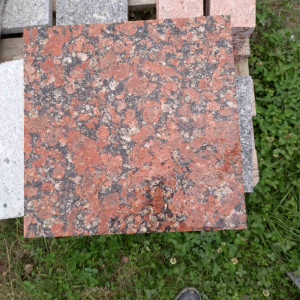 Flamed tile from red granite Rosso Santiago 300x300x30 mm€43.60
 -
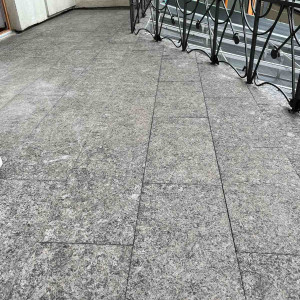 Flamed labradorite tiles 600x300x30 mm€32.70
 -
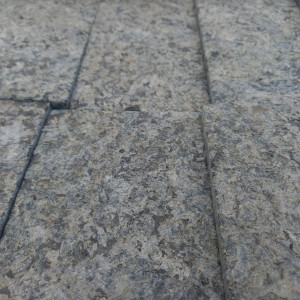 Flamed labradorite tiles 200x100x30 mm€25.70
 -
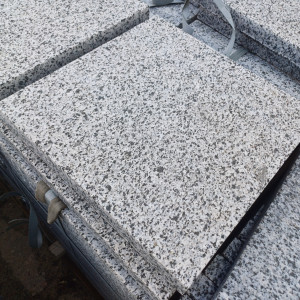 Flamed tile from grey granite Grey Ukraine 300×300×30 mm€31.40
 -
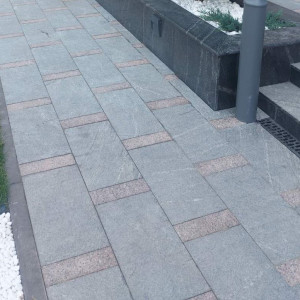 Flamed granite tiles Pantera Grey 600×300×30 mm€61.90
 -
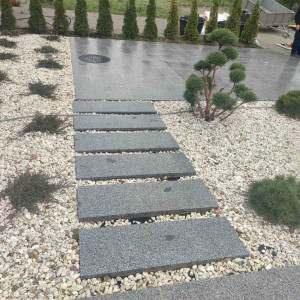 Flamed grey granite tiles 600*300*30 mm€37.60
What thickness of granite tiles where to use?

Surely everyone has seen a burst tile underfoot on the street. Have you ever wondered why this happens? It’s all about the wrong thickness and format of the slab. You have not misheard: the format of granite tiles also affects the choice of the correct thickness. Let’s explain on an example – on a pavement, on a soft base (from gran-sieve or sand) laid a tile thickness of 3 cm. A pattern of tiles with the format 30×30 and 10×10 cm is laid out. Question: which tile will crack faster if cars start driving on the pavement? The answer is obvious – 30×30 tiles will crack faster.
It seems to be easier with facades – buy 20mm thick tiles and rest easy. In general – right. However, if it is necessary to mount a ventilated facade, the use of granite slabs 2 cm thick is not recommended, especially on the basement of buildings.
A 2 cm thick slab on the facade, behind which there is only air and mineral wool, even granite, is spectacularly blown to pieces when young footballers practice their kicks. But slabs with a thickness of 30 mm, as practice shows, are not so interesting for young vandals.
For this reason, we have prepared a list of the minimum recommended thicknesses for different usage situations:
- facade with adhesive (wet) board fixing method – 2 cm;
- ventilated facade – 3 cm;
- granite tiles for the floor in the middle of the room, (wet fixing) – 2 cm;
- floor tiles for outdoor tiling (wet fixing) – 2 cm;
- lining of street stair treads – 3 cm;
- Granite paving slabs (on a dynamic base) gabaritet not more than 20 cm – 3 cm;
- granite paving slabs (on a dynamic basis) gabarit not more than 30 cm – 4 cm;
- granite paving tiles (on a dynamic basis) gabaritet not more than 40 cm – 5 cm;
- large slabs for the pavement – a thickness of at least 10 cm is desirable.

What types of surfaces are possible with granite tiles
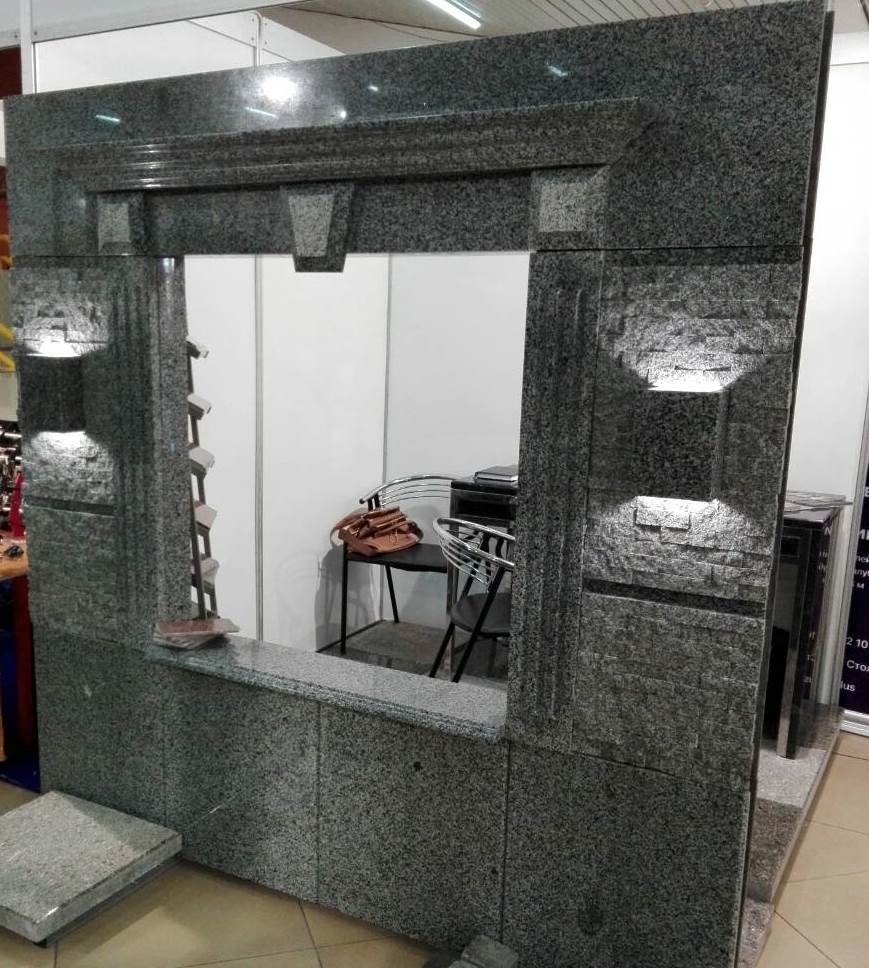
The possibility of making different types of surface on the face of natural stone tiles is the main positive difference from ceramic tiles. Let us explain by the example of our exhibition stand. On the photo you can see a fragment of the facade of grey Pokostovskogo granite, which is made using three types of surface:
Three types of granite tile surface:
- polished – a smooth shiny surface that can be seen on false columns, upper canopy and chamfered capstones;
- flaming – rough as asphalt – in the centre of the capstones;
- split – shining crystal chipped granite – side facade strips.
No other tile, except granite, is not able to so decorate the object of facing. Conclusion: from the most budget granite tiles can be made matchless and texture rich facing of any surface.
You just need to be able to see the end result and have the right equipment and experience. We have combined only three types of surfaces on the stand, but the possibilities of stone processing are much wider. Here are some more types of processing of granite face surface:
Types of granite surface treatment:
- Bush-hammered – treatment with a sharp spiked hammer;
- honed – smooth, even surface without lustre;
- sawn – the surface of the stone after cutting, which is not further processed.
These basic 6 surface types alone open up a huge amount of freedom for design.
Production of granite tiles
In brief, the entire production process can be divided into 4 main stages:
- Sawing of granite blocks on slabs – slabs of the given thickness.
- Surface treatment – for example, polishing or flamed.
- Tile edging in the desired format.
- Packaging of products on pallets.
But it’s not that simple. Quality control is required at every stage. When we cut the block into slabs, we control thickness uniformity and flatness.
Polished or flamed granite surface must meet certain quality parameters. And most importantly – the exact dimensions of granite tiles, which ensure the further quality of laying.
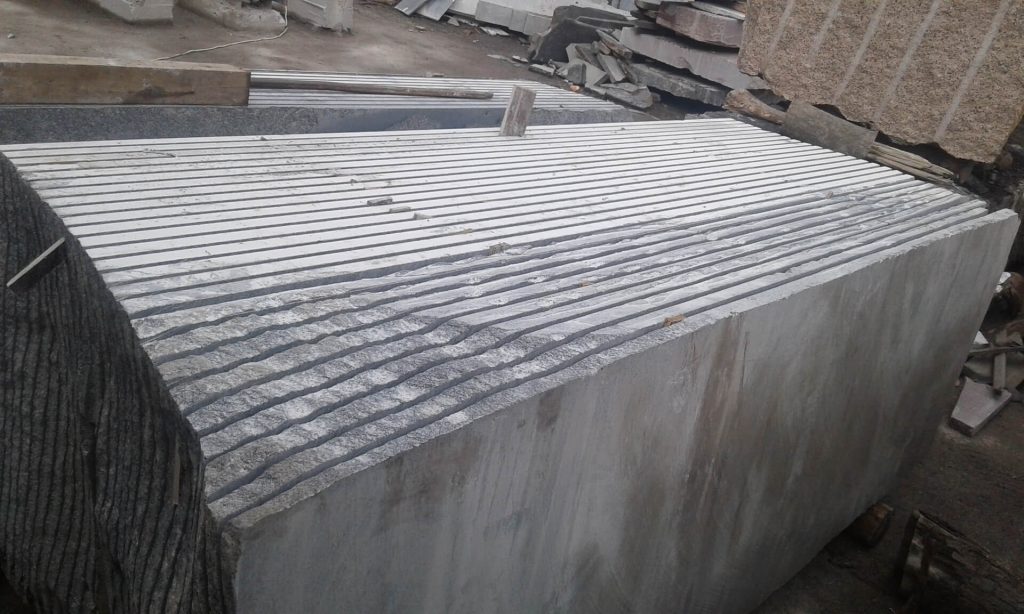
Proceeding from the fact that the main mass of granite tiles has a thickness of 2 and 3 cm, and also realising that for different needs different format is necessary: We maintain stocks of blocks and slabs. And for manufacture of granite tiles from them it is necessary some time.
Properties of granite tiles
You have noticed that ceramic manufacturers clearly indicate for which works their products are intended: for external or only for internal works. The main parameter, which is used to distinguish between exterior and interior applications, is the water absorption coefficient, which determines the frost resistance of our tiles. Clay-based ceramics absorbs water very well, and the water absorption coefficient is between 5 and 15%. All the moisture absorbed by such a tile in winter will tear it from the inside when it freezes. Granite, in turn, absorbs moisture at the level of 0.3-1%. And this is a difference of more than 10 times!!! Granite tiles by their characteristics are suitable for both interior and exterior works.
How often have you seen ceramics worn off on the floor in high-traffic areas? Especially indicative are the places where the cheapest tiles are used – the places of greatest savings become visible after 3-6 months. The abrasion resistance of materials is measured by an ‘obscure’ indicator – g/cm2: how many grams of mass one square centimetre of surface will lose when one million people walk on it. For example, abrasion of enough ‘soft’ Ukrainian granite of Pokostovskoe deposit makes 0,6 g/cm2, and already granite tiles from Didkovichi quarry – 0,3 g/cm2. We should notice that the Didkovichi granite itself is much more difficult to saw and polish. What is the abrasion resistance of ceramics? – We do not criticise our colleagues!
This is the most pleasant highlight of granite tiles. When the years come, even the hardest polished granite with intensive use will have scratches – unfortunately, it is a fact. However, unlike ceramics, when removing the top layer and further polishing, we get a completely new surface. Such renewal can be repeated practically unlimited number of times, as at repolishing of granite tile the top layer in tenths of millimetres is removed, and standard thickness of a tile for a floor – 2 cm. The cost of such a renewal is much less than laying and buying a new ceramic coating. The conclusion is unambiguous – buying granite tiles you make investments, and not bear expenses!
Delivery and packaging

The standard package of granite tiles is a wooden pallet weighing 1-2 tonnes. The weight of a particular package depends on the thickness of the tiles. A pallet with a 30×30 cm tile and a thickness of 3 cm, weighs 1500 kg and holds only 18.63 m2. We always coordinate the format of packing with our customers, taking into account the possibilities of unloading. As practice shows, the most convenient way of unloading at construction sites is unloading by crane or manipulator. Delivery of such products is carried out directly ‘under the door’. We help our customers to find transport, or we conclude a contract with the terms of delivery of goods to the point of unloading.
Price of granite tiles
For detailed prices, to make the right decision about buying a particular type of granite tile, we suggest you contact us:
LET US HELP YOU
Looking for granite tiles? Give us a call (whatsapp), or leave a request – we’ll take it from here.